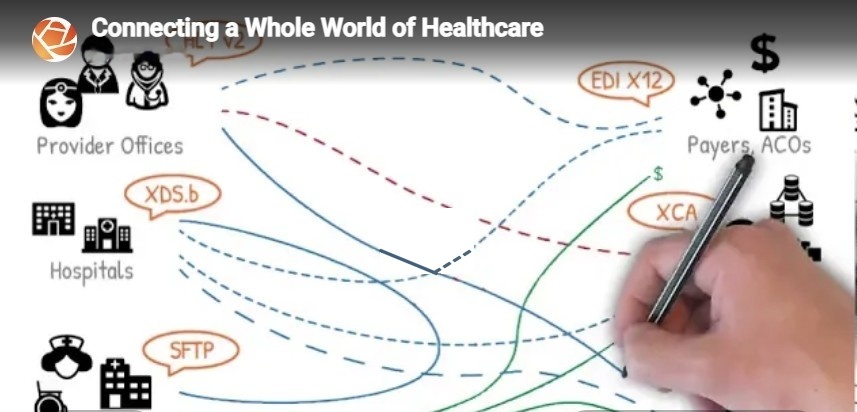
Most people's medical history is scattered. It sits with a primary care doctor, a specialist across town, a hospital system, a clinic visited on vacation, and sometimes providers in other states. Collecting it normally means contacting each provider, filling out forms, and waiting. Under HIPAA a provider generally has up to 30 days to respond to an access request, so a patient who needs records from several places can wait on several clocks at once.
ELDRforyou's medical-records feature, launching November 1, is built to replace that process. Through Eldr-US's partnership with RosettaHealth, subscribers can gather their records across doctors, hospitals, and medical networks into their own ELDRFORYOU database. RosettaHealth describes its GetPatientRecords product as a single connection that reaches records across nationwide interoperability networks, so organizations don't need many separate point-to-point integrations. The patient benefit is the same idea at personal scale: one place to look instead of many.
This also fits where the industry is heading. The federal TEFCA framework is designed to let providers, payers, and patients access and share health information wherever it is stored, and its current exchange purposes include "individual access services," meaning patients accessing and sharing their own information.
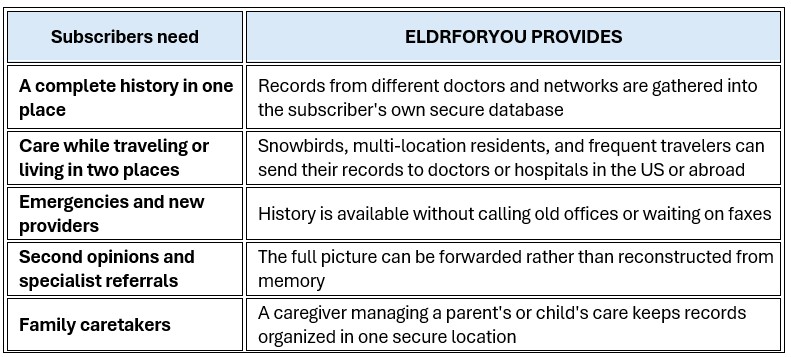
What subscribers get
The caretaker and family angle
Caretakers face this problem most sharply. Whether they are coordinating an aging parent's care across several doctors or a child's evaluations, treatment plans, and progress reports, they are the ones expected to produce the right paperwork on demand. A single repository turns "where is that report?" into a quick search. For families of children with autism, where authorizations and appeals depend on current diagnostic and treatment documentation, that can speed up approvals.
Why this matters to insurers (tying it back)
Everything above also shortens the insurer's wait. A subscriber who can produce a complete, current history can respond to an underwriter's records request, a disability claim update, or a prior-authorization question without the weeks of chasing providers that cause delays today. That connects the patient value directly to the carrier value covered in the earlier sections.
Reference material
- RosettaHealth, "GetPatientRecords" overview: single API for access to patient records across nationwide networks. https://www.healthcaretechoutlook.com/rosettahealth-2026
- RosettaHealth, "Making Data Interoperability Possible for Home Health Agencies": access to records without building separate EHR interfaces. https://rosettahealth.com/blog/2024/6/20/making-data-interoperability-possible-for-home-health-agencies
- ONC / HealthIT.gov, TEFCA overview: nationwide network-of-networks, patient access to records. https://healthit.gov/policy/tefca/
- Surescripts, QHIN updates: TEFCA currently covers treatment and individual access services. https://surescripts.com/qhin
HC Innovation Group, "Understanding the HIPAA individual right of access": 30-day response window, ability to direct copies to a designated recipient. https://www.hcinnovationgroup.com/clinical-it/article/13008353/understanding-the-hipaa-individual-right-of-access-to-health-information