
Most insurance friction comes from missing, outdated, or scattered paperwork rather than from the product. A secure, organized record repository like ELDRforyou.com addresses that, and the benefits go to the insurer as well as the policyholder.
1. Incomplete paperwork is the top cause of claim delays
Life insurance claims typically take 14 to 60 days from filing to payout. Some carriers pay faster, but the most common reason a claim runs long is incomplete paperwork, and a missing signature or uncertified certificate can add weeks. If something is missing, the carrier's clock effectively pauses until the claimant supplies it.
Every pause adds adjuster touchpoints, follow-up letters, and call-center volume, and it leaves the beneficiary frustrated at a bad moment. When a client's policy documents, identification, and supporting records are already organized in one place, the family can submit a clean file the first time.
2. Policies get lost, and benefits go unclaimed
Beneficiaries often don't know a policy exists, can't find the paperwork, hold outdated beneficiary information, or never notify the insurer of the death. Policies also go missing because carriers merge or are acquired, and policyholders move without updating their address, so statements stop arriving.
The scale is large. The NAIC reports that its free Life Insurance Policy Locator has matched consumers with more than $16 billion in lost and unclaimed benefits since 2016, from more than 1.5 million search requests. Benefits that can't be matched may eventually have to be turned over to the state as unclaimed property. That outcome is bad for the beneficiary and for the carrier's reputation, and it adds escheatment and compliance work.
A secure vault gives families a known place to look. They don't have to start from scratch, and starting from scratch with locator tools can take 30 to 90 days.
3. Medical records drive contestable and complex claims
If the insured dies within the contestability period, the carrier may investigate the application, reviewing medical records against what was disclosed. This is one of the slowest and most expensive claim types, and records are often the bottleneck. Attorneys who handle these disputes note that problems arise when providers no longer hold records, HIPAA authorizations are incomplete, or requests for documentation are overly broad.
A client who has already gathered their records from multiple providers into one secure, shareable database makes that process far easier. This matters more with ELDRforyou's medical-records feature, launching November 1. It lets subscribers pull records across doctors and medical networks into their own database and send them to providers in the US or abroad. ELDR-US is partnering with RosettaHealth to connect records across networks, which helps clients who split time between states, travel often, or receive care from several systems.
4. Beneficiary and identity details need to stay current
Outdated beneficiary information can create legal disputes and delay claims. Verifying a beneficiary's identity and relationship to the policyholder can also slow a claim when it isn't clearly established.
A repository that holds the attorney-drafted estate documents, trusts, powers of attorney, and beneficiary designations next to the policy details gives the family and the carrier one consistent source. That reduces conflicting versions and supports faster, cleaner settlements.
5. Security and compliance matter
An insurer can't recommend a document repository that can't protect sensitive information. ELDRforyou is HIPAA compliant, CMMC-1 certified, and SOC 2 Type I, and it encrypts data in transit and at rest. These controls are the baseline a carrier, agency, or compliance team will ask about before endorsing any client-facing tool.
What this means for insurance providers
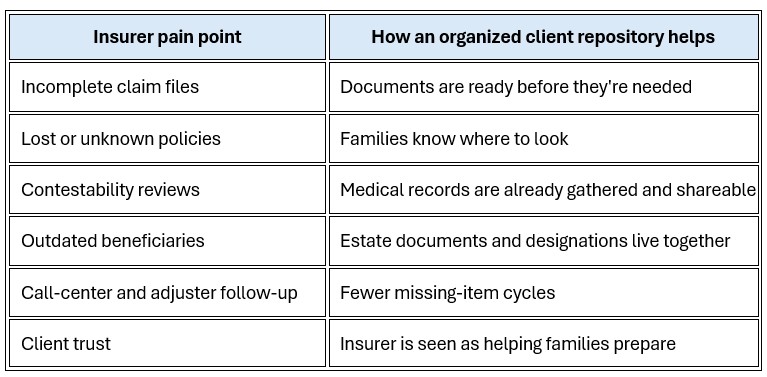
Insurers and agents can offer clients a simple message: get your important records organized and secured now, so your family isn't scrambling later. That helps clients, reduces friction at claim time, and strengthens the relationship.
Learn more at ELDRforyou.com.
Reference material
- Aflac, "How to File a Life Insurance Claim": typical 14–60 day timeline; missing documents as a delay factor. https://www.aflac.com/resources/life-insurance/how-to-file-a-life-insurance-claim.aspx
- Insurance By Heroes, "Life Insurance Claim Documents: Process Explained (2026)": incomplete paperwork as the leading delay; contestability reviews. https://insurancebyheroes.com/life-insurance-policy/life-insurance-claim-documents-process/
- Insurance By Heroes, "Missing Life Insurance Policy? How to Find It": why policies go missing; 30–90 day locator timelines. https://insurancebyheroes.com/life-insurance-policy/missing-life-insurance-policy/
- NAIC, Life Insurance Policy Locator milestone ($16B+ matched). https://content.naic.org/article/naic-life-insurance-policy-locator-tool-helps-match-consumers-more-16-billion-lost-and-unclaimed
- Blumenshine Law Group, "Unclaimed Life Insurance Benefits": why benefits go unclaimed. https://blumenshinelawgroup.com/unclaimed-life-insurance-benefits/
- Life Insurance Attorney, "9 Reasons for Documentation Life Insurance Claim Denials" (a 2023 article, and an attorney's perspective): missing medical records and HIPAA authorization issues. https://www.lifeinsuranceattorney.com/blog/2023/july/9-reasons-for-documentation-life-insurance-claim/
- Ethos, "How to File a Life Insurance Claim": beneficiary verification as a delay factor. https://www.ethos.com/life-insurance/life-insurance-claims-process/