
The post-execution phase of estate planning encompassing Revocable Living Trusts, Financial Powers of Attorney (POA), Healthcare Proxies, Living Wills, and Last Wills present a major structural vulnerability in personal asset management. While the execution of these documents receives meticulous attention, their long-term storage, retrieval, and life-cycle management can frequently lack systemic controls.
When instruments are lost, physically compromised, or rendered inaccessible due to law firm dissolutions, the legal and operational ramifications fall heavily on families, fiduciaries, and institutions.
Core Structural Vulnerabilities
1. The Strict Evidentiary Standards for "Originals"
Unlike standard commercial contracts, estate planning documents carry high legal thresholds regarding duplicate copies:
- Last Will and Testament: Under common law principles across most jurisdictions, if an original executed Will was in the testator's possession prior to death but cannot be found post-mortem, courts apply a legal presumption that the testator intentionally revoked or destroyed it. Rebutting this presumption to probate a copy requires clear and convincing evidence, triggering costly evidentiary hearings.
- Financial Powers of Attorney: Financial institutions, brokerages, and title companies routinely reject digital scans or photocopies of POAs, demanding certified original signatures or "wet ink" originals to limit liability under state banking and agency laws.
- Real Property Transfer Deeds: County recorders and title companies require original, notarized deeds (or certified court orders) to record conveyances in or out of a trust.
2. Attorney Discontinuance and Law Firm Dissolutions
When an estate planning attorney dies, retires, faces disbarment, or dissolves their practice, "custodial drift" creates significant risks:
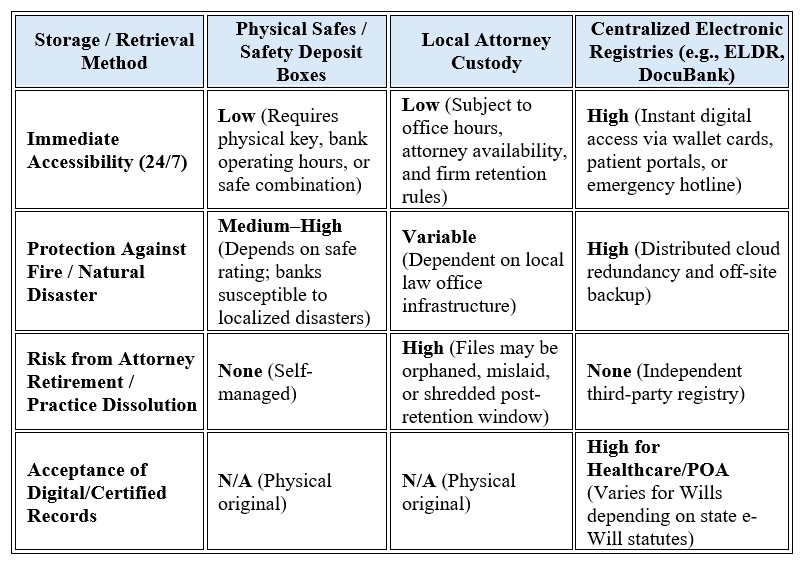
- Orphaned Files: Sole practitioners often lack clear legal succession plans for client files. Original client documents stored in law firm safes or local off-site storage facilities frequently become inaccessible or are destroyed in accordance with firm retention schedules (e.g., 7–10 years after file closing).
- Loss of Attorney-Client Privilege Evidence: Proving intent during a Will contest often relies on the drafting attorney’s notes or testimony. When a firm disappears without transfer protocols, critical contextual evidence is lost.
3. Crisis-Point Inaccessibility for Medical & Healthcare Documents
Healthcare Powers of Attorney, HIPAA Authorizations, and Living Wills carry zero utility if they are unavailable at the exact moment of emergency medical admission:
- Time-Critical Failures: Emergencies occur after business hours, away from home, or during travel. Relatives rarely know where physical documents are stored (e.g., fireproof safes, bank safety deposit boxes).
- Hospital Liability Concerns: Medical providers are reluctant to honor verbal claims of proxy authority without immediate, reviewable documentation, often forcing default medical interventions or emergency court-appointed guardianships.
Comparison of Document Custody Models
Legal Mechanics Impacted by Missing Documentation
- Probate Court Intervention: If a Revocable Living Trust instrument is missing and title to real property was never fully transferred (unfunded trust), the estate defaults to formal court probate.
- Guardianship and Conservatorship Proceedings: In the absence of an accessible Financial Power of Attorney, family members must petition the court for emergency conservatorship or guardianship to manage financial accounts—a process costing thousands of dollars and taking weeks to process.
- Healthcare Proxy Conflicts: Lacking an accessible Healthcare POA, family disputes over medical treatment or end-of-life care decisions often require urgent judicial intervention in family court.
Emerging Systemic Solutions & Digital Registries
To bridge the gap between static paper creation and crisis-point execution, the industry is shifting toward standardized backup frameworks:
- Third-Party Secure Document Registries: Platforms like ELDR (Electronic Ledger and Document Registry), DocuBank, and state-specific advance directive registries store encrypted, validated digital copies of crucial estate and healthcare directives. These services provide beneficiaries, fiduciaries, and healthcare personnel with rapid, 24/7 access through secure credentials or emergency wallet cards.
- State Electronic Will (E-Will) Statutes: A growing number of jurisdictions have enacted versions of the Uniform Electronic Wills Act, allowing Wills to be drafted, executed, notarized, and stored natively in a digital format. These statutes establish strict standards for "qualified custodians" to ensure authenticity and prevent tampering without physical paper dependence.
- Firm Continuity Mandates: State bar associations are increasingly implementing rules that require solo practitioners and boutique firms to designate a "Successor Attorney" or custodial plan to preserve and transfer client original files upon practice termination.