
How Patient-Held Medical Records Help Insurers Across Health, Life, Disability, Autism Claims
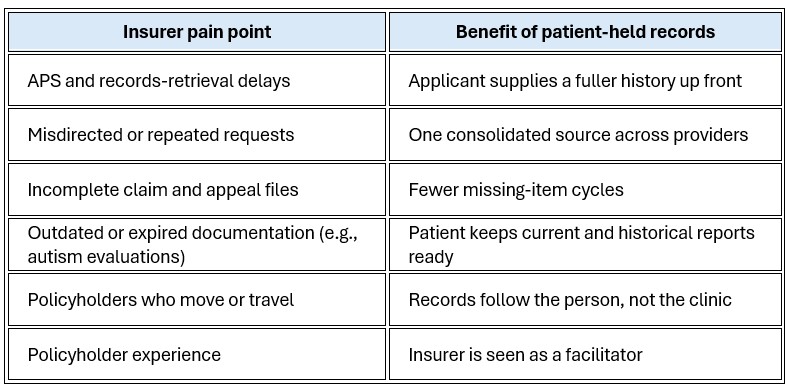
Insurers spend much of their effort waiting for records and chasing missing ones. When a patient can assemble their own history across doctors and networks, the waiting shrinks across nearly every line of business.
The legal foundation: patients can already pull their records
Under HIPAA, individuals have a right to obtain a copy of their health information from covered providers and plans. They can also direct that a copy go to a designated person or entity, and no separate authorization is required to make that request. Covered entities generally must respond within 30 calendar days. A repository that organizes this retrieval for the patient turns a legal right into something usable.
Secure software applications such as https://ELDRFORYOU.com, can organize and store medical records while not only providing access to a patient’s history across doctors, hospitals, and healthcare networks but now also retrieving them. These records are available anytime, anywhere, especially when they are needed most.
1. Life insurance underwriting and claims
The problem: An attending physician statement (APS) is one of the most frequently ordered extra underwriting sources, and one of the most expensive and time-consuming. Industry sources put the added time at roughly two to six weeks. Delays often come down to administrative friction. A physician may work at several clinics, or the request may go to the wrong facility, and the file stalls until someone finds the right source. Records can also reveal other doctors or tests that weren't in the application, which triggers another round of requests.
The patient-held advantage: An applicant who already holds a consolidated history across providers can hand the underwriter a fuller picture at the start. That means fewer misdirected requests and fewer second-round pulls. For claims, medical records are frequently requested when death occurs within the contestability period, so a complete, organized history helps the carrier reach a decision with less back-and-forth.
2. Disability insurance (short- and long-term)
The problem: Insurers rely on clinician notes, test results, and physician opinions to decide whether a claimant meets policy criteria. They often seek a complete medical file up to a set date, plus updates as the claim continues. Records that are incomplete or inconsistent can delay decisions or lead to denials, and claimants' attorneys describe insufficient medical evidence as a leading denial reason, sometimes because the insurer failed to obtain every record. Treating physicians' offices also commonly send incomplete files the first time, which prompts repeat requests.
The patient-held advantage: A claimant with a longitudinal record can submit a complete file from the outset and keep it current as the claim progresses. This reduces follow-up requests and disputes over missing information. It also helps meet deadlines, especially in ERISA appeals, where deadlines may close the record according to the eCFR regulation requiring a complete submission early in the process.
3. Medical (health) insurance
Health plans handle prior authorizations, continuity-of-care reviews, and appeals. Patients who receive care across several systems, such as snowbirds, frequent travelers, and families using multiple specialists, are often the hardest to document. A patient-controlled record that follows them across networks lets the plan verify history, prior treatments, and medical necessity faster.
4. Children with autism (ABA and related services)
This is one of the clearest examples of documentation driving coverage decisions.
- Insurance coverage for ABA is generally tied to a documented autism diagnosis plus documentation that the therapy is medically necessary. Most plans require prior authorization before therapy starts or continues.
- Typical documents include a diagnostic evaluation, referral or prescription, an ABA assessment, a treatment plan, and sometimes school records or prior evaluations.
- Common denial reasons include missing or outdated diagnostic documentation, missing authorizations, and insufficient proof of medical necessity. Some plans require the evaluation to be recent, often within 12 to 36 months.
- Diagnostic evaluations alone can take two to eight weeks to complete and report, and an appeal review after a denial can take two to six weeks.
The patient-held advantage: Families are told to keep diagnostic reports and prior treatment records organized so they can be submitted quickly. A secure repository lets a parent keep the evaluation, treatment plans, progress data, and school records together and send them to the plan or a new provider on demand. For insurers, that means cleaner authorization requests, fewer denials driven by missing paperwork, and faster appeals, which reduces administrative cost and delays to a child's care.
5. Cross-cutting benefits for carriers
A caution for credibility
Insurers will reasonably ask how they can trust patient-supplied records. Within ELDRFORYOU, patients are required to keep sharable documents and information as current within a 90-day certification testament. The strongest version of this value proposition is records pulled from the source systems, with clear provenance, and shared securely. ELDR-US partnership with RosettaHealth to connect records across networks speaks to this point. ELDRFORYOU.com HIPAA compliance, CMMC-1 certification, SOC 2 Type I, and encryption in transit and at rest address the security side. Several of the sources below are claimant-side law-firm blogs or industry marketing, so they are good for illustrating the pain points but are not neutral research.
Reference material
Patient right of access (HIPAA)
- HC Innovation Group, "Understanding the HIPAA individual right of access to health information": right to obtain copies or direct them to a designated third party, 30-day timeline, no authorization needed. https://www.hcinnovationgroup.com/clinical-it/article/13008353/understanding-the-hipaa-individual-right-of-access-to-health-information
- NFP, "HHS Issues Guidance on HIPAA Right to Access Health Information." https://www.nfp.com/insights/hhs-issues-guidance-on-hipaa-right-to-access-health-information/
- Bricker Graydon, HIPAA §164.524(b) timeliness text. https://www.bricker.com/insights/resources/key/HIPAA-Privacy-Regulations-Access-of-Individuals-to-Protected-Health-Information-Requests-for-Access-and-Timely-Action-164-524-b
Life insurance underwriting (APS)
- Wikipedia, "Attending physician statement": APS as a frequently ordered, costly, slow requirement. https://en.wikipedia.org/wiki/Attending_physician_statement
- Set For Life Insurance, "Insurance Medical Records Request": misdirected requests and follow-up records pulls. https://setforlifeinsurance.com/insurance-medical-records-request-approval/
- Effortless Insurance, "Life Insurance Attending Physician Statement": added weeks of processing time. https://www.effortlessinsurance.com/life-insurance-attending-physician-statement/
- Coverly USA, "Life Insurance Underwriting Process in the USA": APS review and administrative delays. https://coverlyusa.com/life-insurance-underwriting-process-in-the-usa/
Disability claims
- The Legal Guide, "Releasing Medical Records to Disability Insurance Companies": role of records in disability decisions. https://thelegalguide.org/releasing-medical-records-disability-insurance-companies/
- Philadelphia Disability Insurance Lawyer, "Repeated Requests for Medical Records in Disability Claims": offices often send incomplete files initially. https://www.philadelphiadisabilityinsurancelawyer.com/repeated-requests-for-medical-records-in-disability-claims-what-they-signal
- Nolo, "Why Long-Term Disability Applications Get Denied": insufficient medical evidence. https://www.nolo.com/legal-encyclopedia/why-long-term-disability-ltd-applications-get-denied.html
- Donahue & Horrow, "When a Long-Term Disability Claim Is Denied": delayed records and the ERISA appeal record. https://donahuehorrow.com/when-a-long-term-disability-claim-is-denied-the-process-is-not-over/
Autism / ABA coverage
- Kennedy ABA, "Prior Authorization for ABA Therapy": process, timelines, outdated diagnostics. https://www.kennedyaba.com/blog/prior-authorization-for-aba-therapy/
- AtlasCare ABA, "Does Insurance Cover ABA Therapy?": typical required documents. https://www.atlascareaba.com/blogs/does-insurance-cover-aba-therapy-what-parents-should-know-before-starting-care
- Blossom ABA Therapy, "How to Appeal Autism Insurance Denial": evaluation-age windows and denial reasons. https://blossomabatherapy.com/blog/autism-insurance-denial
- CareRoute, "ABA Therapy Denied? How to Appeal": documentation and authorization errors. https://www.careroute.ai/blog/aba-therapy-insurance-denied-appeal