
Comprehensive Evaluation of ELDR as a Non-Traditional Employee Benefit for Modern Workforce Caregiving and Emergency Preparedness
ELDR is a secure digital vault and emergency medical ID system designed to streamline access to critical health, legal, and personal records during family crises. Offered as an HSA/FSA-eligible employee benefit, it helps HR departments reduce caregiving-related burnout, absenteeism, and lost workplace productivity.
Executive Overview and Market Positioning
Human resources leadership faces a rapidly changing employee benefits landscape, driven by shifting demographic demands and an aging population1. As the workforce ages, caregiving obligations have surpassed child care as a primary cause of workplace disruption, unscheduled absenteeism, and employee hardship1. Approximately 42% of employees aged 40 to 50 now belong to the "sandwich generation," simultaneously supporting dependent children and elderly relatives3. Caregiving strain accounts for an estimated $44 billion annually in lost productivity and unwanted turnover for employers, with nearly one in four employed caregivers reporting missing work due to care responsibilities1.
In response to these challenges, organizations are expanding benefit portfolios beyond traditional health insurance to include flexible, non-traditional family support solutions1. ELDR, operated by ELDR-US, LLC and accessible via eldrforyou.com, emerges as a specialized technology solution within this space7. Positioned as a secure digital vault and emergency medical access system, ELDR consolidates an individual's medical, legal, financial, and personal records into a centralized, cloud-hosted "life roadmap"4. Founded by President Elaine Hoyt and led operationally by Executive Vice President Tim Lowe out of Loves Park, Illinois, the company provides infrastructure designed to resolve health record fragmentation and support family crisis management2.
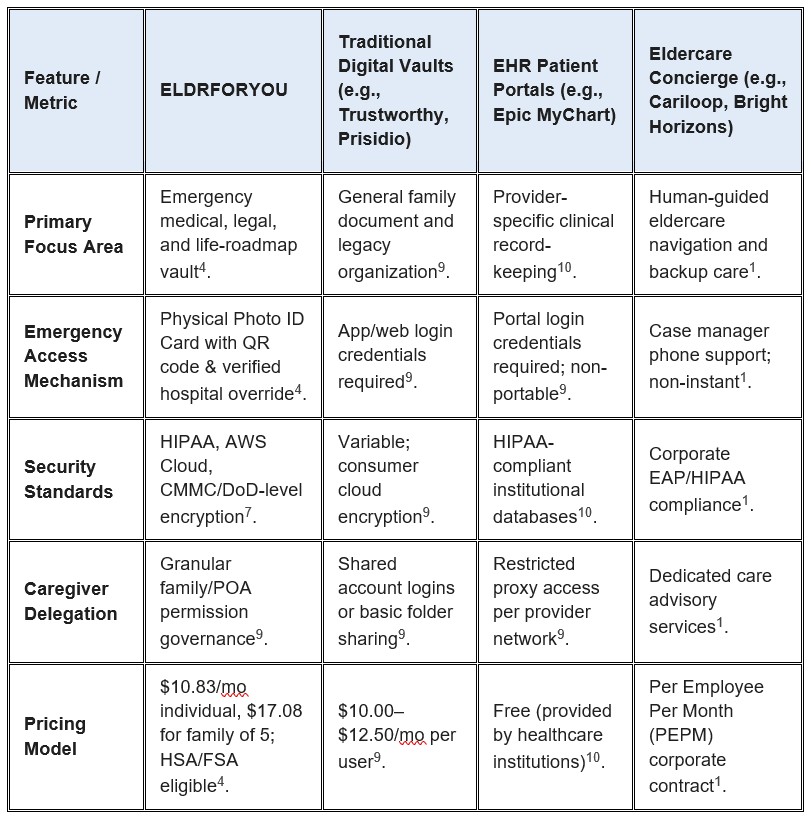
For HR benefits leaders, ELDR functions as a non-traditional, payroll-deductible benefit that directly addresses employee caregiving stress and personal emergency preparedness4. Unlike traditional Electronic Health Record (EHR) patient portals, which are fragmented across healthcare systems, ELDR acts as an employee-controlled document repository9. It allows workers and their designated proxy caregivers to organize critical records—ranging from advance directives and power of attorney (POA) documents to complete medication histories—making them immediately accessible during crises4. By lowering the administrative and emotional burden of caregiving and emergency response, the platform provides HR departments with an innovative tool to improve workforce retention, support mental well-being, and enhance employee value propositions1.
The underlying architecture connects a central, secure Amazon Web Services (AWS) cloud vault to both the employee subscriber and authorized family proxy caregivers7. Input files are strictly formatted as PDFs or JPEGs to preserve system security and prevent executable code vulnerabilities10. On the emergency access side, the cloud vault integrates directly with a physical ELDR Photo ID Card featuring a scannable QR code and high-visibility medical alerts, allowing verified emergency medical personnel to access critical health profiles even when a subscriber is incapacitated4.
Technical Architecture, Security Infrastructure, and Compliance
Evaluating digital record platforms for HR deployment requires rigorous technical scrutiny, particularly regarding data privacy, Protected Health Information (PHI) management, and regulatory compliance9. ELDR is engineered from the ground up to meet stringent enterprise and government security standards14. The platform is hosted on an AWS cloud architecture, offering a scalable infrastructure designed for continuous availability8. ELDR adheres to Health Insurance Portability and Accountability Act (HIPAA) mandates, establishing legally compliant storage and transmission protocols for sensitive health records7. Furthermore, the platform integrates Cybersecurity Maturity Model Certification (CMMC) standards and Department of Defense (DoD) level encryption protocols across all data transaction states—including data in transit and data at rest7.
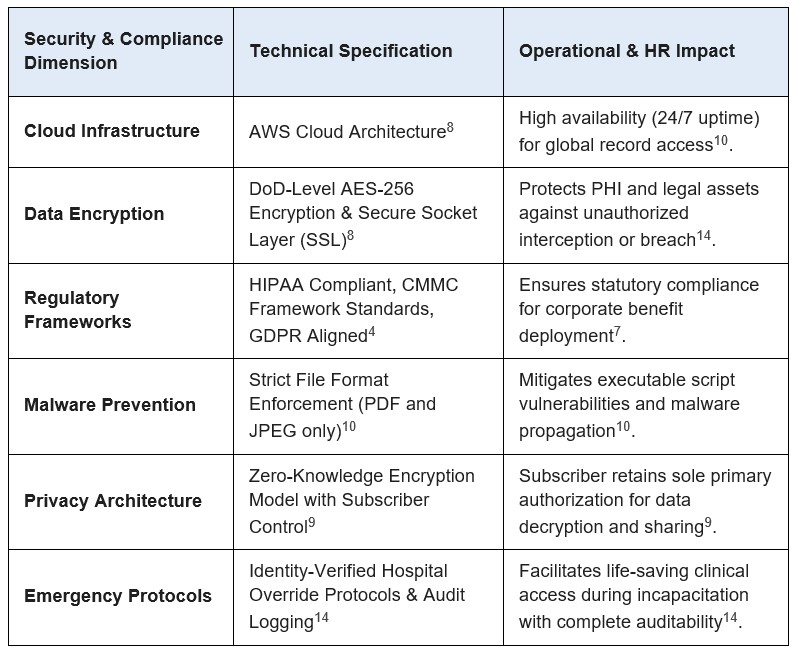
To prevent security vulnerabilities, ELDR restricts repository file formats strictly to PDF and JPEG10. This operational constraint blocks macro-enabled documents, executable scripts, and zero-day malware threats from entering the cloud vault10. The platform operates on a zero-knowledge architectural framework, meaning that files stored in the vault are encrypted using subscriber-controlled keys9. System administrators cannot inspect subscriber file contents9. Granting third-party access—such as sharing medical histories with a specialist, estate attorney, or family member—requires explicit authorization from the primary subscriber9. All data access requests, authorization grants, and document transfers are recorded in subscriber activity logs to maintain complete auditability9.
For acute medical emergencies where a subscriber is incapacitated, ELDR incorporates an identity-verified emergency override protocol14. Hospital emergency personnel can access life-critical health profiles only after undergoing strict identity verification procedures14. This dual setup balances daily zero-knowledge privacy with emergency override capabilities, solving a major issue found in typical password managers and cloud drives during medical crises9.
Core Capabilities and Employee-Facing Features
Understanding how ELDR functions from the employee's perspective requires examining its primary service modules: record consolidation, emergency identification tools, designated caregiver access, and travel support4.
Major health networks rely heavily on EHR portals like Epic MyChart10. While effective for institutional documentation, EHR systems create significant data fragmentation when patients see multiple healthcare providers10. An ongoing medical care plan can generate massive, unstructured clinical records across disparate provider portals, making it difficult for families to locate actionable information during an emergency10. ELDR operates as an abstraction layer over these fragmented clinical portals10. Rather than acting as an exhaustive clinical warehouse, ELDR allows subscribers to curate, logically categorize, and store essential life records across four distinct categories10:
- Medical Profiles: Surgical histories, chronic conditions, immunizations, diagnostic scans, bloodwork results, current medication lists, and primary physician contacts4.
- Legal Directives: Living wills, durable powers of attorney (medical and financial), advance healthcare directives, and trust structures4.
- Household Financial Continuity Plans: Insurance policies, household financial management instructions, real estate deeds, and emergency contact lists4.
- Personal & Family Roadmap: Comprehensive household instructions, key contact directories, and family access credentials4.
A key physical component of the platform is the ELDR Photo ID Card provided to subscribers4. Designed to fit into a standard wallet, the card provides physical access to cloud-stored emergency health profiles without requiring app downloads4. The card features a visual photograph for identity verification, full legal name, and a unique ELDR ID number to eliminate patient mismatch risks4. High-visibility medical alerts—such as diabetic status, penicillin allergies, or implanted pacemakers—are printed directly on the card face for rapid identification by first responders10. Furthermore, a scannable QR code allows emergency clinicians to access the subscriber's secure cloud profile, while a 24/7 toll-free helpline ensures live support during critical events4. To assist working caregivers, ELDR offers granular account delegation options4. Working parents can create and manage sub-profiles for dependent children10. Similarly, adult children managing aging parents can be designated as caregivers or Medical Power of Attorney (POA) proxies10. Account owners can grant restricted read, write, or emergency access to specific folders in the vault9. This helps family members stay aligned on eldercare plans, medical appointments, and legal preparations without exposing unrelated personal financial documents4. Beyond document storage, ELDR includes several integrated support services4. A toll-free helpline (855-428-3537) operates continuously to help subscribers and authorized family members navigate technical issues or update emergency records during crises4. For business travelers or remote workers abroad, ELDR coordinates with foreign hospital networks and manages international air transport arrangements if medical evacuation is required4. ELDR also works alongside agencies like the Department of Veterans Affairs (VA) to help subscribers compile and consolidate fragmented medical histories needed for disability claims4. Finally, the platform offers curated directories of elder law attorneys for estate planning and partners with quality agencies to provide hospital and physician rating data, helping subscribers evaluate institutional safety standards, such as hospital infection rates7.
Strategic Value Proposition for HR and Employer ROI
Introducing ELDR as an employer-sponsored benefit provides strategic advantages across talent management, risk mitigation, and corporate benefit design1. Unscheduled employee absences due to eldercare emergencies disrupt team operations and lower output1. Caregivers often lose work hours to administrative stress—such as locating mislaid legal directives, requesting medical files from multiple clinics, or tracking down insurance paperwork during family crises1. Centralizing family health information into an accessible digital vault significantly reduces this administrative friction1. In a traditional eldercare emergency, an employee faces immediate crisis triggers that force them to navigate disparate medical clinics and fragmented portals, leading to extended work absences, heightened emotional strain, and lost organizational productivity1. Conversely, an ELDR-enabled caregiving workflow allows the employee or designated proxy to immediately access the central digital vault or scan the ELDR ID card4. This provides instant access to critical health histories and legal directives, streamlining emergency decision-making and allowing the employee to maintain professional continuity with minimal work disruption1. By streamlining crisis management, ELDR helps lower absenteeism and presenteeism among working caregivers, enabling employees to manage family health issues faster and return to work with fewer lingering distractions1. In competitive hiring environments, traditional benefit offerings such as standard medical, dental, and 401(k) plans are viewed as baseline expectations5. Offering specialized caregiving and personal emergency preparedness benefits allows employers to differentiate their total rewards package1. Data indicates that 87% of HR leaders consider dedicated caregiving policies vital for attracting and retaining top-tier talent1. Providing an enterprise solution like ELDR demonstrates an organizational commitment to holistic work-life integration1. It directly supports multi-generational employees—from Gen X and Millennial caregivers to Boomers preparing for retirement—strengthening organizational loyalty and lowering voluntary turnover1.
Financial Architecture, HSA/FSA Eligibility, and Implementation
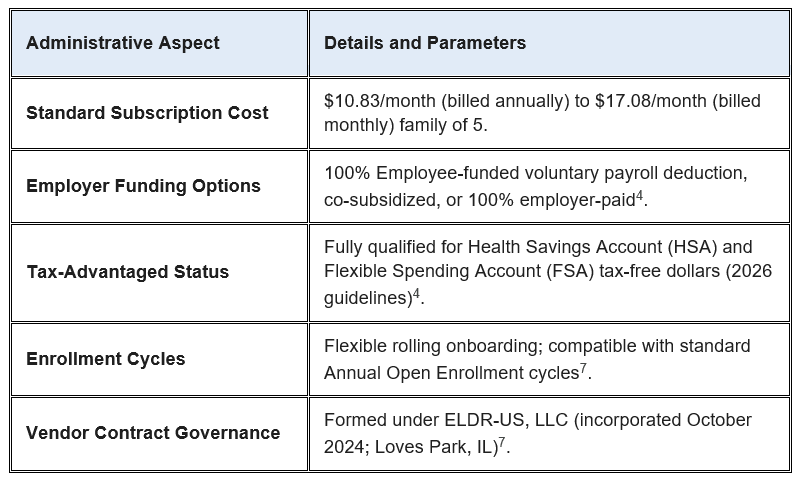
Integrating ELDR into an existing corporate benefits package requires evaluating its cost structure, tax treatment, and administrative implementation options4. Standard individual plan subscriptions range from $10.83 per month under an annual billing structure to $17.08 per month for a family of 5. As of 2026, ELDR subscriptions qualify as tax-free HSA and FSA eligible expenses4. This tax status allows employees to pay for their subscriptions using pre-tax health accounts, reducing out-of-pocket costs4. Employers can structure ELDR through two primary funding models4. Under a voluntary payroll deduction model, employers offer ELDR as an opt-in non-traditional voluntary benefit4. Employees fund their accounts via direct pre-tax payroll deductions or through HSA/FSA funds, eliminating direct benefit costs for the employer4. Alternatively, under an employer-funded or co-subsidized model, employers cover the subscription fee ($10.83/month per participating employee) as a fully sponsored or co-subsidized perk9. This option works well for high-stress roles, executive teams, frequent international travelers, or working caregivers who need immediate support1.
To achieve high platform adoption, HR teams should execute a structured, four-phase deployment plan4. Phase one begins with a workforce needs assessment, surveying employees to gauge caregiving responsibilities, travel frequency, and interest in emergency document preparedness18. Phase two aligns open enrollment communication with HSA/FSA pre-tax messaging and payroll deduction setup4. Phase three focuses on employee onboarding and data input, guiding workers through converting essential files into PDF or JPEG formats and setting up proxy access for family members4. Finally, phase four achieves active operational readiness through the issuance of physical ELDR Photo ID Cards, activation of scannable QR profiles, and access to 24/7 dedicated telephone support4.
Operational Risks, Limitations, and Vendor Evaluation
While ELDR addresses a clear gap in family preparedness, HR buyers should evaluate operational risks and vendor-specific limitations prior to deployment7. ELDR is an active document repository rather than an automated, direct-feed clinical EHR connection9. The platform relies on subscribers to manually gather, scan, convert, and upload their medical, legal, and financial records4. Employees with low digital literacy or limited time may find this initial setup challenging4. Additionally, health data requires ongoing maintenance—such as updating medication logs or replacing expired directives—to remain accurate during emergencies4. If employees upload outdated files, the system's emergency utility diminishes. From a procurement perspective, ELDR-US, LLC was incorporated in October 2024 and formally listed with the Better Business Bureau in October 20257. As an emerging entity in the corporate benefits space, the company lacks decades of enterprise-scale performance history7. HR procurement teams should conduct standard vendor due diligence to review data backup redundancies, platform SLA guarantees, financial stability, and vendor continuity plans in the event of platform disruption9. Finally, employees can be hesitant to upload sensitive legal, financial, and medical documents to an employer-sponsored platform due to privacy concerns9. HR departments must communicate clearly that ELDR is an independent, zero-knowledge repository9. Employers hold no administrative access, visibility, or ownership rights over the data stored in employee accounts9. Clear communication regarding HIPAA compliance and privacy safeguards is essential to build trust and encourage voluntary enrollment7.
Strategic Conclusions and Recommendations
ELDR offers a compelling, modern answer to the growing problem of workforce caregiving stress and emergency health record fragmentation1. By combining zero-knowledge cloud storage with physical, offline access tools like the ELDR Photo ID Card, the platform bridges the gap between daily document management and acute emergency readiness4. Its HSA/FSA eligibility and payroll deduction options make it an accessible, low-cost addition to corporate benefit programs4. For HR leadership, deploying ELDR is a strategic, low-risk way to enhance total rewards offerings1. It directly supports working caregivers, reduces unscheduled absenteeism, and protects employee well-being1. While successful implementation requires clear employee communication and ongoing account engagement, ELDR provides significant value for organizations committed to supporting a resilient, multi-generational workforce1. Human resources leaders considering ELDR should first deploy the platform via HSA/FSA-eligible voluntary payroll deductions4. This setup offers immediate employee utility without adding direct subscription costs to employer benefit budgets4. Initial communication campaigns should target high-impact workforce segments, such as sandwich generation caregivers, frequent international business travelers, and remote employees who require centralized emergency tools3. Simultaneously, HR procurement teams must conduct thorough vendor security due diligence to verify that contracts guarantee HIPAA compliance, AWS cloud redundancies, CMMC/DoD encryption standards, and complete employee data ownership7. Finally, onboarding should be integrated into broader EAP and wellness initiatives, pairing ELDR rollouts with existing legal assistance and eldercare support resources to help employees establish a complete personal, medical, and estate roadmap3.
References
1. Why Employers Should Offer Elder Care Employee Benefits - Cariloop, https://cariloop.com/blog/offer-elder-care-benefits-to-your-employees
2. ELDR Media: Blogs, Videos, Press & Newsletters, https://eldrforyou.com/media/
3. Elder Benefits - CarePatrol, https://carepatrol.com/elderbenefit-helping-employees-2023/
4. ELDR: Secure Medical and Document Storage, https://eldrforyou.com/
5. Elder care benefits: 5 ways employers can help employees with ageing parents, https://www.thanksben.com/blog/elder-care-benefits
6. Unraveling Elder Care Employee Benefits: The Ultimate Guide - Compt, https://compt.io/blog/unraveling-elder-care-employee-benefits-the-ultimate-guide/
7. ELDR-US, LLC | BBB Business Profile | Better Business Bureau, https://www.bbb.org/us/il/loves-park/profile/data-storage/eldr-us-llc-0654-1000127400
8. ELDR-US | Secure Medical Record Storage, https://eldr-us.com/
9. Best Digital Vault: Find the Right Fit for Your Needs - ELDR, https://eldrforyou.com/blogs/best-digital-vault/
10. How ELDR Works: Keep Your Documents Safely Accessible, https://eldrforyou.com/how-works/
11. Elder Care Benefits for Employees | Bright Horizons®, https://www.brighthorizons.com/employers/benefits/elder-care-employee-benefits
12. Offering elder care benefits to caregiver employees - Higginbotham, https://www.higginbotham.com/blog/elder-care-benefits/
13. Contact ELDR: We're Here to Help, https://eldrforyou.com/contact/
14. Secure Medical Record Storage - ELDR-US, https://eldr-us.com/about/
15. https://en.wikipedia.org/wiki/Employee_benefits
16. Elder Care | Homeland Security, https://www.dhs.gov/employee-resources/elder-care
17. Family Operating System: Build a Calm, Reliable Household Plan | ELDR, https://eldrforyou.com/blogs/family-operating-system-how-to-build-one/
18. Elder Care Benefits Guide for Employers - Helpr, https://www.hellohelpr.com/feeds/blog/elder-care-benefits